
Ever considered launching a ministry or publishing a Bible study from your personal story?
Julie Fowler knows what it’s like to step out with a dream that feels bigger than you. After walking through years of infertility and loss, her pain turned into purpose as she built the ministry she needed in that season. Now, 25 years later, she’s published her curriculum as men’s and women’s Bible studies for people who are walking through a similar trial.
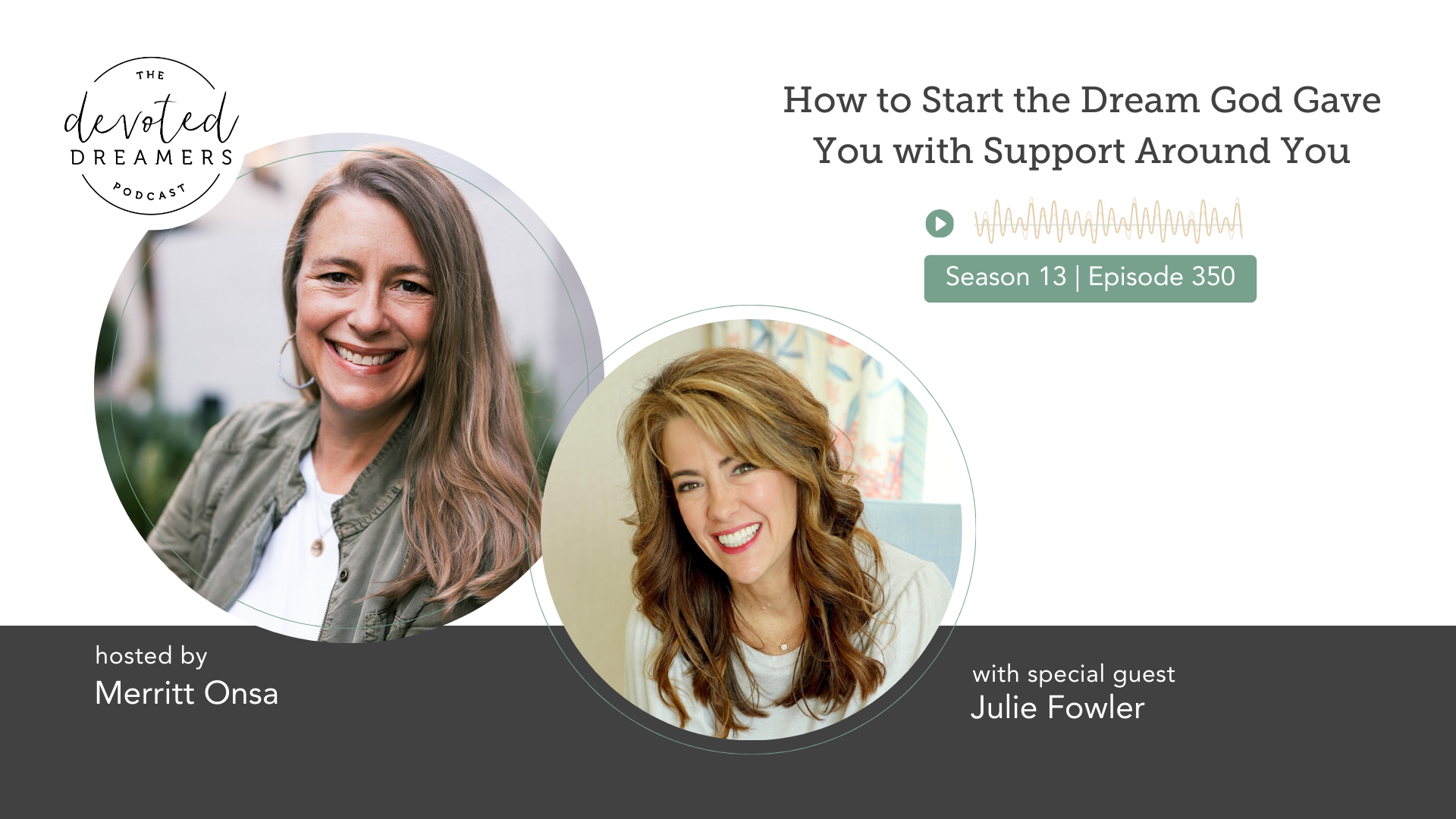
IF YOU’VE EVER WONDERED ABOUT SELF-PUBLISHING, THIS IS THE EPISODE FOR YOU.
Julie and I talk about the challenges and joys of saying yes to God’s invitation and the spiritual growth that happens when you pursue a God-shaped dream with open hands.
Here’s what you’ll learn:
📚 The pros and cons of today’s book publishing options
🙏 How to grow in faithfulness as you pursue your calling
🤝 Specific ways to ask for the support you need as you go after that big dream
Whether you feel called to write, start a ministry, or simply live more boldly for Christ, Julie’s story will remind you that God can use your unique journey to bring hope and restoration to others.
Press “play” and let this episode encourage you to keep moving forward in obedience.
Then, download my 7-day devotional: 7 Truths to Silence the Voice of Self-Doubt, a short and powerful guide to help you remember what’s true so you can take the next step forward in your God-shaped dream.
CONNECT WITH MERRITT:
Website || Facebook || Instagram
CONNECT WITH JULIE FOWLER:
Website || Facebook || Instagram
MENTIONED IN THIS EPISODE:
Ep 346: Why Your God-Given Dream Doesn’t Have to Look “Typical” (34 mins) Apple | Spotify
Julie’s Books for women:
Treasures in the Waiting Leader Guide
For men:
Navigating Infertility and Loss with Strength and Hope; Men’s Bible Study
Navigating Infertility and Loss with Strength and Hope; Men’s Bible Study - Leader Guide
Scripture:
You intended to harm me, but God intended it for good
to accomplish what is now being done, the saving of many lives.
~ Genesis 50:20 (NIV)
For the eyes of the LORD move to and fro throughout the earth
that He may strongly support those whose heart is completely His.
~ 2 Chronicles 16:9 (NASB)
For I know the plans I have for you,” declares the LORD, “plans to prosper you and not to harm you,
plans to give you hope and a future.
~ Jeremiah 29:11 (NIV)
Enjoy This Episode?
Here are some others you might also like:
Bonus Ep: Where to Find Deeply Supportive Community for Your Dream (11 mins) Apple | Spotify
Ep 308: 3 Reasons Why Community is Essential for Chasing Big Dreams (27 mins) Apple | Spotify
Ep 282: The Right Community Will Fuel Your Dreams w/ Terri Albrecht (22 mins) Apple | Spotify
Ep 285: Want a Supportive Space to Bring Your Dream to Life? (28 mins) Apple | Spotify
PIN IT FOR LATER:
The unedited transcript for this episode of The Devoted Dreamers Podcast follows:
Hey, dreamer—
You’re listening to the Devoted Dreamers Podcast. And today we are talking all about:
How to Start the Dream God Gave You with Support Around You
And this is a milestone episode – we’ve hit #350 -- 350 episodes! And I just want to pause and say thank you here at the beginning—thank you for being here, whether this is your first episode you’ve ever listened to or your fiftieth. It has been one of the greatest joys of my life to walk alongside Christian women with God-shaped dreams and to speak into your journey of dreaming with God.
And I cannot think of a better way to celebrate this milestone than with part two of my conversation with Julie Fowler—author, speaker, pastoral care leader, and executive director of Julie Fowler Ministries, a 501(c)(3) nonprofit organization.
If you’ve ever tried to carry a God-given dream all by yourself—either because asking for help felt scary or you just didn’t know where to begin or who to talk to—this is the episode is for you.
Julie shares what it looks like, in very practical ways, to go from idea to impact. She walks us through the real, behind-the-scenes process of deciding how to publish her Bible studies, of building an online presence, launching a nonprofit ministry to support women and couples who are walking through infertility and loss.
But what stands out most is her deep reminder that faithfulness—not flashiness, not doing everything in the “right” way—faithfulness is what God asks of us. That inviting others in doesn’t make you weak; it actually makes you wise. And that even if your dream feels too big or your next step is still uncertain, you are not alone.
There’s support for you and your dream, and there’s space for you in the Kingdom work God is calling you to.
So sit back and relax. Enjoy this episode with Julie Fowler.
Hey there, in case we haven’t met…
I’m your host Merritt Onsa – a Christian life coach — kinda like the Joanna Gaines for women of faith who have big dreams about how God might re-order the second half of your life — so you can use your gifts and life experiences to usher in beauty, redemption, healing and service to others.
It’s not a re-design for your home that we’re working on….
It’s a brand-new way to live — in freedom… free from fear, free from second-guessing yourself all the time, and free from the lies that the enemy has used to keep you quiet and playing small in the past.
Isn’t it about time more of us who believe in Christ started living that way?!
I’m on a mission to engage 10,000 women worldwide to start taking intentional and purposeful steps that will bring their God-shaped dreams to life!
If you believe in Jesus, and you see His work in your life and are aware that you’ve been given gifts, talents, and a life story that could serve and benefit others. … maybe you’re among those 10,000.
I hope that you are…
Because you’re here listening to a podcast about dreams – maybe you’re looking for a chance to see if your dream has LEGS. You want to try it on for size and figure out if it’s possible. You want to be inspired and encouraged that there’s hope for what you’ve been dreaming all these years.
Maybe you’ve been too fearful in the past. Or someone dashed your dreams with a comment that hit too close to home. Or you just haven’t had time to figure out how to proceed.
Well, my friend…This is your time. This is your space.
If you have big ideas for how God could use the gifts He’s given you and the years of your life that remain, and you have a dream that would serve others – let’s figure out how to turn that heartfelt hidden dream into real, actionable plans with impact for God’s kingdom work in the world.
Julie Fowler, welcome back to part two. We are just going to keep on going on this conversation about your ministry, your Bible study, your nonprofit. Can you give like a, like a one sentence little update about who you are in case somebody's coming to this episode for the first time having not heard part one?
Julie Fowler:
Yes. Oh, thank you for having me.
I started Julie Fowler Ministries and it is a nonprofit to help lay leaders and churches launch infertility and miscarriage ministries to comfort, equip and encourage couples that are dealing with infertility and loss, because it just affects every aspect of a person and people are asking really deep spiritual questions and God and Jesus in the Bible, they have so much encouragement for us, so much hope. And so my heart is for people to draw closer to God during this time and to see how much in his word he has for us.
Merritt Onsa:
Yes. And I should have said this in part one, but what a gift your ministry and your Bible studies are. We struggled with infertility if anybody knows our story. And it's a lonely season or lifetime depending on how long that goes on. And it's just such a, a gift for you to take your story and let God use it to encourage others.
So Lord, may you make it fruitful and plentiful in churches where men and women and couples just need support. Just really so glad that He's prompted you to do this work.
Julie Fowler:
Thank you.
Merritt Onsa:
So in this, part two, we were going to talk about just kind of some of the steps that you took to specifically turn this curriculum into a printed, published Bible study and to start your non profit.
And so you talked a little bit about this in part one, but what were some of the things that you needed to do to figure out how do I even do this now that this choice is in front of me?
Julie Fowler:
Yes. So when I decided to, you know, keep the study and, and work on it myself as opposed to letting my church develop it, I really had to decide whether I wanted to try to publish it like traditional publishing and maybe get a literary agent to try to help me with that or and make a book proposal and all of that, or if I wanted to self-publish or if I wanted to do hybrid.
And years ago I looked into these options and had considered hybrid publishing but didn't feel like it was the time. And so now I was at, at this point of decision. So I talked to a lot of people, just kind of word of mouth, friends I knew who had published, and I talked to some people who had self-published and so just kind of got a feel for what that entailed. And I heard pros and cons. So I also got. I'm involved with something called Flourish Writers, which is really designed for Christian writers.
And a lot of people in Flourish Writers are writing either Bible studies or, you know, some kind of Christian book. And across the board, they might be doing traditional, hybrid, or self-publishing. So that was another good resource.
And eventually I decided that self-publishing was going to be my way to go. One reason was because I learned that it would be quicker and I also would have more control. And so those were two things.
Even though I was going to have to foot the bill or come up with the funding for it, I did like the idea that it was faster and I would have more control over the content because I had been using it for so long and felt, you know, pretty strongly about what was in it.
And so that's just what I chose personally. But it really did help to be part of some of those groups and to talk to different people.
Merritt Onsa:
Yeah. And for those who may not know the difference, like with hybrid, what is. How does hybrid differ from self or traditional publishing?
Julie Fowler:
You have someone, and sometimes it's an arm of a traditional, like Thomas Nelson Publishing has an arm that does this. And you're still paying money. They will help you. They will help you come up with a cover design, they will help you format it and do some editing. And there's different levels that you can pay. So they're kind of provide. It's almost like a contractor and subcontractor.
They will help provide the people, but you're still paying some money.
Merritt Onsa:
Okay. Yeah.
Julie Fowler:
And you still. You still. Actually, I've heard this with even traditional publishing, you still have to work really hard from a promotion standpoint, no matter which way you go.
Merritt Onsa:
Right.
Julie Fowler:
But if you go through a traditional publishing, you've got their name, you've got some of their connections, things like that.
Merritt Onsa:
They'll put your book in their little magazine.
Julie Fowler:
Yeah, yeah. But I did kind of hear that with that hybrid, that kind of middle road, that you can end up spending still a lot and still have to do a ton of the work.
Merritt Onsa:
Yeah.
Julie Fowler:
Um, and so.
Merritt Onsa:
Right. So if you're going to do the work anyway, that's why you chose self-publishing.
Julie Fowler:
So, I mean, I do have a friend who's done that, and I think for what she wanted to do is just the perfect fit. So I think it just depends on your goals.
Merritt Onsa:
Yeah, no, that's really Helpful. Um, so you talk to people. You participated in groups online. What were some other…
Julie Fowler:
No, well, I had to. I decided to self-publish.
Merritt Onsa:
Yeah.
Julie Fowler:
And I decided to self-publish through KDP, which is an arm of Amazon. And one of the reasons why I wanted to do that is because, like I said, the timeline and things like that, but I also didn't want to be in the shipping business myself. And so because I had been doing that for several years where I would box up my Bible studies and send them, and I'm not great with that. And so I thought this is really great because it's print on demand. And so when. Sure, I can just say here, you know, they're on Amazon, you can order them. And there's pros and cons of that, that I would be happy to talk to somebody about that.
But because I also lost control over who had them. Whereas before, I could maybe vet a church and say, you know, this church is vetted. So now you can have my books because I'm in line with you. Whereas now really, anyone who wants to do it can do it.
Merritt Onsa:
Right. So what you're saying is referring people to a ministry in a place that you have no contacts, you can't really track them.
Julie Fowler:
I don't necessarily have to. Yeah. I'm not necessarily putting myself out there to refer to everyone, but I'm just saying anyone can host. Anyone can order my studies and host them online. And so there's the advantage of more of those. So, yeah, there's just. It can be a little bit messy.
And that's where all those things. And I think. So another tool that has been really helpful. Well, for me, it's only been helpful the last few months, but this could be very helpful for someone is to put these kind of decisions in Chat GPT as another form of counsel.
I don't recommend ChatGPT to replace prayer, listening to the Holy Spirit, seeking counsel from your husband and others who know you, obviously, like those are irreplaceable. But I do think that some of these decisions, had I had them back then, this would. I would have used this as a tool of.
This is important to me. These are some of my prior priorities. What do you recommend? And sometimes Chat GPT with something like that. I have not put that specific question in, but sometimes it will say, well, if this. This is the way you could go, or this is the way you could go. So it won't always spit out the answer, but it might help you narrow down and think through and you can kind of have a dialogue with it. It can also, if you're trying to navigate what your next steps are, you can put all the things that are swimming in your head and put them in ChatGPT and say, these are all the things I'm feeling I need to do.
Can you help me prioritize? Can you tell. Help me figure out what to do first?
Merritt Onsa:
Yes.
Julie Fowler:
That's amazing. And I didn't have that back then. I'm trying to think of ways to use it now, but I think that's another great tool that someone could put in some different aspects of their dream. Like, for me, I knew I need to have a website. I knew I wanted. Well, eventually I had to decide if I was going to be for profit or nonprofit, so I had to navigate that. But putting in these are some of the things I'm considering. What do I need to tackle first?
Merritt Onsa:
Yes. Yeah, that's such a great point. I used, from the perspective of prioritizing tasks. When I was getting ready to go on vacation, I was like, I have this many days and these tasks, and it helped me kind of narrow down where things could go in the schedule. It doesn't. Oh, it's not perfect. Right. But like, you know, it's like, well, no, I'm not going to work on a Saturday.
Or, you know, May 31st is not a Thursday. Like, it's like, you gotta, you gotta be on top of it. But yeah, that has been a helpful tool as well for me. So, what else?
Julie Fowler:
And I have found that I have. Okay, so for the longest time. Well, like when I first learned, oh, I could use ChatGPT as like a personal assistant kind of thing. Well, I first was just always just Googling. I mean, putting in my Safari browser, my Chrome browser, ChatGPT. So I was always just starting fresh as like a guest user.
Merritt Onsa:
Oh, yeah.
Julie Fowler:
Well, if you do it that way, they're not learning who you are and they're not learning. So I have created an account. Mine's. Mine's a free account. My husband has a paid account, but I have a free account. But it, it now everything that I've put in so far is kind of stored. So I don't always have to tell people what my ministry is about, what my nonprofit is, who, you know, what I'm doing. It kind of can build on it. And then so every time you plug something in, you can just go from there. And that's really neat.
But when I do think it is, well, it was very, very beneficial for me to meet with a marketing / branding person, and this person was able to listen to my ideas and also map out some next steps and then say they could help me with stage one, they could help me with stage two, they could help me with stage three, and it depended on what I wanted to pay.
So I could just say, I only want you to help me with my branding and my kind of big picture plan. That's like stage one, I think. But, you know, every person does it differently. Do I want this person to design my website or do I want to try to do that on my own? So I've. And I've had friends who have also used a similar person, and we've chosen different ways to use this person.
But, like, a lot of times you can find a marketer where you can just say, hey, can I just use you as a consultant for an hour? Or can I buy this little package of three hours from you or make this plan? And I think those kind of things can be helpful when you're starting to pursue a dream also.
Merritt Onsa:
Yeah. So you've used that for figuring out, like, online presence. I've seen you a lot on social media lately, so do they help you with some of that as well?
Julie Fowler:
I have.
Merritt Onsa:
Or you have a teenage daughter?
Julie Fowler:
Well, yeah, no, I am. So early on, she helped me. She made some templates for me in Canva, and again, I'm still learning Canva.
Merritt Onsa:
Your daughter or your marketing person?
Julie Fowler:
My marketing person started me that was part of a package that I got from her, was like, she'll put together a few templates just to kick me off.
Merritt Onsa:
Yeah.
Julie Fowler:
And I mean to, you know, get me going. And then I've just had to learn as I go. And I love that you talk about in Dream Believers a lot on the podcast. It has really encouraged me because it can be so hard to put stuff out there as a beginner when you feel like, okay, is this so lame? Or is this cringy or is this. And I think that you almost just have to do it. You just almost have to try and learn as you go. And it's super painful. But as, okay.
So my background is as a speech pathologist, and I had a boss who used to say, no one's going to die of a speech disorder. Now, again, we're not talking about swallowing. You can we work on swallowing too. Like that's all another thing. But like, it's okay, you know. Anyway, so if you make a mistake, yeah, you can make a mistake. And again, we're always learning.
But. And again, this was when I was first out of school. But I go back to what she used to tell me when I was first out of school with speech therapy. And I keep telling myself, Julie, no one is going to die from a lame social media Instagram post. Like, it is, okay.
And my daughter cracks me up. So one of my daughters is 17 and she'll go, mom, it's not that deep. And so, you know, it kind of puts me in my place. Like sometimes I do have to tell myself, Julie, just pick a song.
Just pick a song to go with this post. Like, it's three seconds of someone's life. Yeah, it's three seconds of someone’s life. So I think just learning and being okay with having. I mean, I'm not going to do it as well as if I was hiring someone.
Merritt Onsa:
Right.
Julie Fowler:
But I did reach out to someone who was a young person who's just graduated with the graphic design, all this marketing. And I was like, how much would it cost to pay you to do a reel? And she said it would be a hundred dollars for a reel. And I was like, I can't pay a hundred dollars for a Reel. Like, you know, yeah. If I'm wanting to do three reels a week. So that just told, told me, okay, my time is valuable so I'm going to figure out what is worth. And we're all different, right? With what is going to be something we're going to pay for and what we're not or what we even have any funds to pay.
Merritt Onsa:
Exactly. Yeah.
Julie Fowler:
But I decided for myself, if I also, if I pay someone, I'm not going to be learning. So it's worth it to me to. And it is sometimes so painful. So, so, but just to, just to learn as I go and pick a couple, pick a couple voices to train me and listen, I realized that there were some people that I'm like, okay, that's overwhelming to me and that is too detailed. I gotta not follow you anymore because your tips are stressing me out because it's just too much.
It's too much for me. So I think that was another thing is just like get some voices and counsel and training, but don't. If you do it, if you get too much.
Merritt Onsa:
Yeah, I totally agree.
Julie Fowler:
Number 1, it's overwhelming. And then, then I also get paralysis by analysis.
Merritt Onsa:
Oh, yeah. Like, which thing do I actually listen to? Because I can't do all these things in the same day. Or week.
Julie Fowler:
Yeah.
Merritt Onsa:
Or month.
Julie Fowler:
And you just had a, you just had a podcast on. It's okay if it's different.
Merritt Onsa:
Yeah.
Julie Fowler:
Like, if you're, if you're, if your approach is different, if your dream is different, if you're going about this a little differently. And I really loved that because it is a little different what I'm offering, because a lot of people in this infertility space, they are in the midst of it. They are doing the play by play of trying to get pregnant online. And that's, that's helpful for some people to feel like you're in the trenches with me. And what did your doctor say today?
Merritt Onsa:
Yep
Julie Fowler:
That's not the space that I'm in. And so it's okay. So even just realizing I asked God if I was supposed to be in this space and he confirmed that I am, again, I'm taking it kind of a year at a time. I don't know how long he's going to have me in it, but he had me complete the curriculum and publish it, which I'm so excited about.
He had, I feel, called that I was, you know, to start this nonprofit and be a voice and help people. And it's okay that it's different. It's okay that I'm not in the trenches as the 25-year-old. I'm a different voice that can offer something a little different.
Julie Fowler:
Whereas I get it because I was there. But then I also have some perspective. So I'm just trying to be faithful with where I am today. And I love. There's a quote that I had them on my fridge for a while. It's by Mother Teresa. And she said, the success of loving is in the loving, not in the result of loving. And that to me also pertains to faithfulness.
The success is just in being faithful, not in the results. And it's again, this is so neat. This is so neat how God ties all these things together. Because our church, we're reading through the Bible in a year and we're in Jeremiah. And we were just learning how Jeremiah was told at the beginning that he was not going to be successful in getting the people to repent and to avoid consequences. Like he was begging them, telling them, please turn back to the Lord, do not keep worshiping idols. Do not keep doing all these things. And he was, he was spending all his time, and he was getting persecuted for it also.
And he was not going to be successful in that the people were not going to turn away, but he was successful in that he obeyed the call and he did do what he was supposed to do, and he did give them all the chances to do that.
And so I have really been thinking about that this week with just the calling that I'm. It's not up to me for results, so it's not up to me for the likes on Instagram. It's not up to me for the churches that say, yes, we want to use your curriculum or we want to start a ministry. But I, I am responsible to steward and give him glory and try to point people to truth and point people to God's comfort, and then the rest is up to him.
And I was thinking about that, like, what if I'm Jeremiah? Like, what if, what if God had told me, Julie, you're going to do this, you're going to write this study. And this has not been the story, but I was just thinking, like, what if God were to say, you're going to write this study, I want you to do it, and you're going to start this nonprofit and you're going to get like, nobody or two or I would be able to say, you know what? I'm like Jeremiah. And like, we, we all know Jeremiah. You know, we know a lot of the verses in Jeremiah for I know the plans I have for you, says Lord.
Jeremiah 29:11. How many of us know that? But do we know that he was actually, he felt absolutely rejected in his message, and yet we're using his message. And so it's like, we don't even know. Jeremiah doesn't know that I'm using that verse to encourage my heart. You know what I'm saying? So we don't even know the fruit. We don't even know the outcome. And so I think that's. That's one thing.
That's one thing that spurs me on is when you are being called and then you're just saying, lord, help me to be faithful, and I'm going to mess up. I'm not always going to be faithful, but just help me to be faithful and help me just to do what I can and to lean on you today for the next thing. For the next thing.
Merritt Onsa:
Yep. And I have to keep going back to you when I don't see the results that I seek and trust that it's in your hands. Yeah.
Julie Fowler:
Yeah.
Merritt Onsa:
Well, on that note, what are some other places in Scripture that have helped you persevere. What are some spiritual disciplines that have just been consistent for you over time that you've clearly, like, needed and implemented?
Julie Fowler:
Well, I think definitely just have to be continually in the Word and learning and growing spiritually to keep being able to minister to others. And so I do think that that is something that. And I need. I need community to do that. So, you know, when I'm in a Bible study with other women and we're studying the Bible, or like I said, our church is reading through the Word. Like, I think that having. Having people around me also doing that, that helps me to stay in the Word because it can sometimes be lonely. And then.
And I'm inconsistent with memorizing scripture. I will say, when I am memorizing scripture consistently, I am able to hear God that much more personally and actually, like, hear him speak to me because it's through Scripture. Yeah, so that's definitely been a spiritual discipline, but I'm kind of inconsistent with it.
Merritt Onsa:
Ebb and flow.
Julie Fowler:
Ebb and flow, yeah.
Journaling again. I've some, Some. Some seasons of my life, I'm really heavy into journaling. And other. Other times I take a break, but I think journaling my prayers, journaling my thoughts, my frustrations, and you know, with this dream, I mean, sometimes I feel alone or I feel really misunderstood or not seen. And sometimes journaling that and just really getting quiet with the Lord of saying, Lord, it's you and me again. You know, we're. I just got to tell you how I'm feeling with this. And he can meet me in that time when I, like, put it to pencil and paper.
And I would say taking breaks or rest is. Has been really good for me. And I like, you know, Merritt. You model that.
You know, you modeled that recently with your mom passing, and you probably didn't even take as much time as, like, you could have, should have, whatever. But I mean, you did, like. And I gave myself permission this summer, and I'm kind of still going. Oh, is that okay? But I took some, like, I'm not going to post anything because I just need a break. And so I think just building in breaks is also really important. And then one more. If I can just.
I know I'm mentioning a lot, but asking for support. And I think that I've realized on this because I. Like I said, I can still feel alone at times. So I've asked. I have a small group for my church. We have a. We call it a community group. It's like a small group. There's seven of us in the whole group, but there's four of us women. And we're all busy doing different things. Like, we have different ministries, different jobs, different things going on with our families. And I felt like, because they. They weren't in my group when I was walking through all this infertility and loss. So they know I do this.
They know that this is part of my story. They know I'm passionate about it, but they haven't lived the whole thing with me. So I kind of felt like it was very much background for them, and they didn't understand what it was taking to do what I'm doing. Like, all the steps to publishing, all the steps to getting a website, and starting a nonprofit, and getting a board, and getting approved to be a nonprofit. I just wasn't feeling very understood. And so I kind of just thought. And I wrestled with this a little bit, but I finally just decided, I'm going to go ahead and ask them to ask me about it and just tell them how I'm feeling about it and say, you know.
And so I just went to them and said, you guys are amazing encouragers. Like, you're encouragers by nature. So I would love to ask you to start asking me about what's going on. We meet every two weeks. So, like, hey, tell me what's going on with Julie Fowler Ministries. What's going on? What's going on with your social media? Like, what's hard right now? What are you celebrating? And I just said, hey, these are some questions you could ask me. And also, if you could just, like, congratulate me when something. Congratulate me on the wins.
Like, I am inviting you to be in my cheerleading squad because we all need it. And we had been doing it for someone else in our group. And so I was like, I think they just need me to say that I. I kind of want it and need it.
Merritt Onsa:
Yeah.
Julie Fowler:
You know, so. And they were. They've been. They were like, absolutely. And. And then it's been great because now I kind of feel like I've got more people that can ask me about it, pray about it. Like, it gives me more community to. To even ask for prayer.
And so that's just. I just would encourage people to bring other people in. And I mean, sometimes even our own families don't know how to encourage us.
Merritt Onsa:
Right, exactly. Unless you tell them.
Julie Fowler:
Right. And I mean, I have a husband who's in the commercial real estate finance world and he doesn't like to talk about work at home, and so he really doesn't. But, like, I would love to talk about mine. So part of that's maybe husband-wife differences. But, you know, I think, and I haven't really thought about this, but I thought I probably could ask him and say, hey, can you just ask me, like, what was one. One win today and maybe one hard thing today or.
Oh, another thing that someone taught me one time is a rose, a bud, and a thorn.
Merritt Onsa:
Yes. My kids do this.
Julie Fowler:
Yes. So, like, what's something that's going well is beautiful. You're excited about what's a bud? Like, there's potential here. It's up and coming. Like, I'm looking forward to it. And then the thorn, like, what is just. Yeah, the hard thing. And so just.
Anyway, I think asking people for what you need and to be part of your cheerleading team, I just recently did that. And so I'm encouraging other people to try it.
Merritt Onsa:
I love that. Because the people who love you want to know how to love you well. And if you don't tell them, how will they know? They can't read your mind.
Julie Fowler:
Yeah. And I don't have to take 20 minutes, you know, I mean, I can give it in a little two-minute blurb?
Merritt Onsa:
Right! Yeah.
Julie Fowler:
So I have to be sensitive to, not like just talk their heads. Yeah, they're not as interested in. Yeah. But yeah, they do. They do want to love us.
Merritt Onsa:
Well.
Julie Fowler:
We’re giving them the opportunity.
Merritt Onsa:
There's also the awkward. Like somebody comes up to you at church and says, how's the blah, blah, blah? And you're like, oh, I wasn't prepared for that. You know, like, you want to respond, but in the moment you're not thinking about it or whatever. But if you ask people to ask you, then you're more, I think, prone to know how to answer it when it comes.
Julie Fowler:
Yes.
Merritt Onsa:
That's great. Well, is there any other advice that you would give for someone who is maybe where you were at the very beginning? Hasn't invited people into their dream or their story yet or is just kind of feeling alone. What would you say is this like a next step for her to start to open up that door to people in her life?
Julie Fowler:
I think it'd be really neat to talk to and talk to someone who you feel like knows you and it's kind of that friend who loves you. And I mean, it could be a spouse, it could be a friend, it could be a family member, but just someone who knows you well and thinks highly of you and just say, what do you see are my strengths? And then tell them kind of what you're thinking. And then, you know, maybe ask them to pray with you about it. Have a partner to pray, say, you know, and maybe even do it right then, you know, will you just be praying with me? And maybe you pick even a day like, hey, can we just pray? And let's just say Tuesday mornings? And it doesn't have to be together necessarily, but just say, hey, will you make Tuesday a day that you're praying with me about this? So I think that'd be a great step is because, number one, you're, you know, you're praying about it, and number two, you're asking someone to speak into it.
Merritt Onsa:
Yeah.
Julie Fowler:
And kind of affirm some things, like, what do you see being the roadblocks? Or what do you get excited about that for me? What am I not? What am I not seeing? That might be difficult, you know, because somebody might say, hey, I don't know about the other things going on in your life right now or the timing or…
I mean, there's been also times where I thought something was not possible and talking it through someone's like, well, no, I can totally see you doing that now. So I think just having another voice and maybe even more than one person would be ideal, you know, because sometimes there's that collective.
Merritt Onsa:
Yeah. Synergy or.
Julie Fowler:
Yeah.
Merritt Onsa:
Ideas.
Julie Fowler:
Collective council. Yeah. And there's so many proverbs about counsel. And, you know, with many advisors, plans succeed and others.
I have a lot of them in my. In my curriculum, but just there's, you know, just the. The wisdom of getting counsel before moving ahead. And I mean. And I'm talking about free counsel. You know, just people who know you before you move forward with maybe getting some professional counsel, of sitting down with someone to help you actually map stuff out.
Merritt Onsa:
Yeah.
Julie Fowler:
And using ChatGPT.
Merritt Onsa:
Sure. On the side.
Julie Fowler:
Yeah. On the side. Yeah.
Merritt Onsa:
This has been really fun, really rich conversation. I love knowing a little bit more of your backstory and the things that you're working through, the ways that you're inviting your people in your life into it. And I'd love, before we go, could you tell us the. The names of your studies? We know we can get them on Amazon. And then also the best place for people to connect with you if they want to know more about the infertility ministry or even talk to you about your dream and your experience of doing this.
Julie Fowler:
Yes, thank you for asking. Yes. The women's study is called Treasures in the Waiting and Finding God's Comfort, Counsel and Companionship Amid Infertility and Loss.
And then the husband study is it, it overlaps. It's similar in some of the topics, but it is shorter and a little bit simpler. And it is called Navigating Infertility and Loss with Strength and Hope. And then I've written leader guides to go with each of those and those are all available on Amazon and also through my website.
Merritt Onsa:
Okay.
Julie Fowler:
And the website is juliefowlerministries.com and all of my social media is the same. Julie Fowler Ministries. So on Instagram and Facebook, Julie Fowler Ministries.
Merritt Onsa:
Great. I'm going to link all that in the show notes. And sweet friend, it's just been so neat to do this with you. Congratulations on all the good work that God is doing in and through you.
Julie Fowler:
I would love, I would love to encourage people with a couple verses that have really encouraged me. And One is Genesis 50:20. And that's when Joseph is talking to his brothers and he says, you intended to harm me, but God intended it for good to accomplish what is now being done, the saving of many lives. And since you encourage us to engage with our God shaped dreams, I just think that verse is really encouraging that God can take any hard thing, whether it's a hard, hard story, like hard trials in our lives or just the hard friction of starting a dream. You know, sometimes it's just that, that friction, but God can use it to accomplish what's being done, which is the saving of many lives.
And I take that to mean, when Joseph was talking about it, he was also talking about obviously saving the Israelites from the famine, and the Egyptians from the famine. But I think of it as just bringing the gospel to people and bringing hope and encouragement to people. And so anytime, if there's just one person that can benefit from something that we're doing, then that is worth it.
And that's a lot of encouragement.
And then 2 Chronicles 16:9, the eyes of the Lord go to and from throughout the universe looking to strongly support those whose hearts are completely his.
And he wants to support us in what we're doing. And he has shown that time and time again, I know, in both of our lives. And so I think those are great. When we start to get discouraged, know that God's eyes are on us. And he wants to support us.
Merritt:
As I reflect on the milestone of this 350th episode, I can’t help but think about all the women—like you and me—who are carrying a quiet dream from God and just need one more reason to keep going, to take that next step.
I hope Julie’s story gave you some practical ideas about how you might do that today.
Maybe you heard something that reminded you that it’s good to ask for help. Or maybe you’re realizing it’s time to stop waiting to feel “ready” and simply take the next step with God—maybe that next step is inviting someone else to walk with you.
If this conversation stirred something in your heart, would you take a moment to share it with a friend? Or send me a message on Instagram, I’m @merrittjo—I would love to hear how God is using this podcast in your life and in your God-shaped dream.
And again, thank you for being part of this milestone 350th episode. I’m so grateful for you, for the community of dreamers, and for the work God is doing through your obedience and courage.
Keep going my friend. Your faithfulness is never wasted.
Finally….
Daughter of the King,
You were made for a beautiful purpose, your identity and security rest in Him, as does your dream because the Lord is good and His ways are always good!
No weapon formed against you will prosper because you belong to Him.
Until next week, stay faithful, keep dreaming and remember: trusting God with your next step doesn’t mean it isn’t going to be scary. It means taking the step anyway. That’s what faith is.
You’re welcome here among women braving those scary steps in faith, knowing our dreams matter because they are His.
Until next time,
I’m Merritt Onsa, your dream coach and sister in Christ, walking by faith, with you, in the dream.
Have a great week!
MORE ABOUT THE DEVOTED DREAMERS PODCAST:
Subscribe and leave a review on Apple Podcasts.
Join the Devoted Dreamers Facebook Group
Follow Merritt on Instagram || Facebook || Pinterest
The Devoted Dreamers Podcast is produced by Jonathan R. Clauson.
Theme music by Reaktor Productions.
Ad music by Komiku.